Showing posts with label Energy Secretary Cho. Show all posts

Monday, April 02, 2012

Gas Could Hit $8.00 On Iran Showdown, Experts Say..... USAToday Report


Gas Could Hit $8 On Iran Showdown, Experts Say

Gas prices could double if Iran acts to close the Strait of Hormuz to oil-tanker traffic near the beginning of next year, cutting global economic growth by more than 25%, a leading energy-consulting firm says.

Iran lacks the military might to close the strait for long, but it may be able to disrupt global oil supplies for up to three months by laying mines in the 6-mile-wide shipping passage that the U.S. and its allies would have to find and remove, analysts at IHS Global Insight said on a conference call with reporters Wednesday. About 17 million barrels of oil a day pass through the strait, or nearly 20% of the global market.

Brent crude oil prices could briefly hit $240 a barrel in the first quarter of 2013, said Sara Johnson, senior research director for Global Economics at IHS. Brent, the benchmark European oil, which IHS uses as a proxy for global prices, closed at $123.07 in London Thursday. In the U.S., West Texas Intermediate, the benchmark U.S. crude oil, closed at $105.35 a barrel.

Prices could stay as high as $160 in the second quarter before reverting to somewhere around $120, she said. The firm forecast that such an oil shock could bring back gas lines in much of the world, and shave global economic growth next year to 2.6% from a current forecast of 3.6%.

"If it did hit $240, you're looking at about a doubling of where gas prices are now," said Jim Burkhard, managing director of the global oil group at IHS CERA, the firm's energy-research arm. "And the U.S. is at $4."

Closing the strait probably wouldn't be in Iran's best interests, but its leadership often fails to act in ways that Westerners consider rational, said Farid Abolfathi, senior director of the IHS Risk Center. The firm's analysis assumes the strait would be closed at the start of 2013, as Iran reacts to pressure to stop development work on nuclear weapons.

Sheikh Sabah al-Ahmad al-Sabah, the ruler of Kuwait, said on state media Tuesday that Iran had assured its neighbor it would not close the strait, despite its public threats to do so.

IHS' energy-related forecasts attract attention because of the reputation of Daniel Yergin, chairman of the IHS CERA division, formerly known as Cambridge Energy Research Associates. Yergin's books include the best-seller The Quest, about the evolution of energy markets since the end of the Cold War, and 1993's The Prize, a Pulitzer Prize-winning history of the oil industry.

The firm's outlook is gloomier than some economists' assumptions. In an interview earlier this month, Moody's Analytics chief capital markets economist John Lonski said U.S. gasoline prices would reach $4.75 a gallon if Iran closed the strait.

The impact would be so large because global oil supplies are so tight, said Burkhard. The world has only 1.8 million to 2.5 million barrels a day of unused production capacity, down from 6.2 million in 2009.

Tight inventories magnify the impact of any interruption in crude from nations around the strait, he said. Much Iranian crude has already been taken off world markets because of international sanctions.

If gas prices doubled, consumers could spend an extra $145 a month for gasoline, said Nigel Griffiths, chief economist at IHS Automotive.

Tuesday, March 13, 2012

Barack Obama's Oil Lies are Rooted in His Contempt for the United States of America... Posted March 8, 2012 by Conservative Bytes..

Barack Obama's Oil Lies are Rooted in His Contempt for the United States of America


replacing oil is not going to make energy cheaper. Oil is the cheapest form of energy, for what it provides, that we have. That's what the market does. The market provides the cheapest and the most efficient of everything. Or it won't survive. Eventually it'll go kaput. It's called competition. Oil does not have any competition right now, not any serious competition.
Great to have you back, Rush Limbaugh and the EIB Network, the Limbaugh Institute for Advanced Conservative Studies. Telephone number if you want to be on the program, we will get to your calls in this hour, 800-282-2882.
So Obama's in North Carolina, yeah, we're gonna have alternative energy, gonna bring down energy costs. Nope, they're gonna skyrocket. President Obama wants higher energy costs. Barack Obama wants higher gasoline prices. When it hit four dollars a gallon years ago Barack Hussein Obama said he was only unhappy about how fast the price got to four dollars. He was not unhappy that it did get to four dollars. His Nobel prize-winning energy secretary, a guy named
Steven Chu, said that they have no interest in lowering gas prices; they just want to get us off of oil. Not possible. That's what the free market does, folks, it gives you the cheapest and most efficient of everything. If there were something better than oil it would have been found, it would have been invented. If it were cost sensible, if it was affordable, if it made sense to produce it. It doesn't. Oil is it. It's the beauty of free markets.
Free markets tell you what work. So whatever he comes up with as his alternative, A, there isn't one, and, B, it's simply a way to raise taxes and raise prices and raise costs. You say, "Why would he want to do that?" Well, to accept the answer to that you have to — (interruption) Yes, I am saying algae is not better than oil. That's right, President Obama proposed algae as a substitute for oil a couple of weeks ago. Algae. Pond scum, for those of you in Rio Linda. Why would he want higher prices? Why does he want higher taxes? Well, you have to understand what he thinks of America to answer that and to believe the answer.


Wednesday, March 07, 2012

Beck and Guests Dissect Skyrocketing Gas Prices and Obama Admin's ' Misleading Facts About Oil Production.... by Mytheos Holt March 5, 2012

GBTVBECK AND GUESTS DISSECT SKYROCKETING GAS PRICES AND OBAMA ADMIN'S 'MISLEADING FACTS ABOUT OIL PRODUCTION'

On Monday, Glenn welcomed two guests with quite a lot to say on the subject of energy prices to dissect the Obama administration's "misleading facts about oil prodcution." The first of these was Jack Gerard, President and CEO of the American Petroleum Institute (API). The second was the founder of Cross Consulting and Services and author of the book "Secret Weapon," Kevin Freeman:

Both men brought ample knowledge of the field to the program. Gerard has been the head of API — the foremost trade association for oil companies — since November 2008, after a long career in public service. From his bio at API's website:
Gerard has led API since November 2008, expanding its membership and influence in all 50 states and globally, adding offices in Dubai and Singapore to its operations in Beijing, enabling API to better inform the public and policymakers on important energy issues. API's Washington presence is the foundation for the oil and natural gas industry's advocacy and outreach at state, federal and global levels on public policy, standards and certification programs, and as the source for information on industry best practices.
Gerard is recognized by numerous publications and his peers as one of Washington's most influential advocates.Washington Life magazine named him one of the city's "Power 100" and a Fortune magazine profile said Gerard's effort to build a 50 state advocacy network for the oil and natural gas industry was "showing signs of success" through its outreach to workers and non-traditional allies.
Prior to joining API, Gerard served as president and CEO of the American Chemistry Council, and earlier held the same position at the National Mining Association. Gerard also spent close to a decade working in the U.S. Senate and House. He came to Washington in 1981, and worked for Rep. George Hansen. He also worked for Sen. James A. McClure, who chaired the U.S. Senate Energy and Natural Resources Committee.
Freeman, meanwhile, runs a company known simply as Freeman Global Holdings, LLC., which operates at the global level trying to gauge world markets for clients. His book alleges that foreign countries deliberately sabotaged the United States economy. From his bio:
Kevin Freeman is considered one of the world's leading experts on the issues of Economic Warfare and Financial Terrorism. He has consulted for and briefed members of both the U.S. House and Senate, present and past CIA, DIA, FBI, SEC, Homeland Security, the Justice Department, as well as local and state law enforcement. He has traveled extensively with research trips to Russia and China and throughout Europe and the Americas.
Glenn opened the segment with a quote from Energy Secretary Steven Chu that gas prices should be "boosted" to the level of Europe (around $10/gallon now). He then segued into speaking with Gerard about the effects of Obama administration policies on the energy market. Specifically, Glenn pushed Gerard on the topic of why oil imports have decreased in the United States, as President Obama trumpeted in a recent weekly address. Gerard's response is below:
That's factually correct, but let me tell you why it's misleading. The reason our imports are down is because demand in the United States has dropped significantly because of the recession. So either the President is impliedly taking credit for the downturn in the economy or he's taking credit for the increase in domestic production, which is what we in the industry have done on state and private land.

Obama's Pump Dream.. March 7, 2012 by John Myers....


Obama’s Pump Dream

March 7, 2012 by  
Obama’s Pump Dream
“This president, systematically, is doing everything he can to raise the price of energy in this country. He’s shutting down all sorts of opportunities for us to drill for oil.”
–Rick Santorum
If you think gasoline is expensive now, just wait and see the price at the pump if Barack Obama is re-elected. His policies have steadily dragged the country toward $5 per gallon. If he gets another term in office, affordable gas will be a faint memory. And that will have Obama and his Green backers tickled pink.
The Obama Administration doesn’t seem to care that every 1 cent increase in the price of gasoline costs the economy $1.4 billion. America is becoming more dependent on Muslim oil while turning its back on a half-century energy alliance with Canada. This has been made evident by the President’s rejection of the Keystone Pipeline.
When Obama was sworn into office, the price of gasoline was $1.80 a gallon. Three years into his term, prices for some Americans are approaching $5 per gallon.
That is just the way Obama likes it. Given another four years, gasoline prices could reach $8 a gallon. This is because Obama has a greater allegiance to the Green Machine that drove home his victory in 2008 and that is fueling his chances for another victory lap come November.
The specifics of what the President promised to the environmentalists if he is re-elected remain a secret. But what we know for certain is that Obama clamped down on deep-water drilling inside the Gulf, tightened Federal restrictions for onshore oil exploration and vetoed the Keystone Pipeline, a major oil artery that would secure dependable Canadian crude to a nation thirsting for oil.
Senator Kay Bailey Hutchison (R-Texas) said the evidence is in, that the Obama Administration has willfully brought higher prices to the gas pump because it has put an embargo on fresh and dependable sources of North American petroleum.
“We can’t slow down global demand for oil and gas, but we can do a lot more here at home to assure that we have the energy we need and to halt skyrocketing costs,” Hutchison said. “President Obama’s policy has resulted in an unprecedented slowdown in new exploration and production of oil and gas.”
Speaker of the House John Boehner said the President has been reckless in mismanaging the nation’s energy policies.
When added up, not passing the Keystone Pipeline and “scrapping leases for oil-shale development” makes the President responsible for $5 gasoline, read a press release from Boehner.
“The Obama administration has spent more than three years blocking efforts to expand energy production and bring down gas prices, while pushing job-crushing tax hikes and taxpayer-backed loans to companies like Solyndra.”
Boehner laid out a timeline showing Obama’s purposeful drive to sending gasoline prices higher:
  • Jan. 7, 2010 – The Obama administration announces new bureaucratic hurdles to American energy production that Secretary Salazar admitted “could add delays to the leasing and drilling process.” Gas is $2.67 a gallon.
  • March 31, 2010 – Instead of opening new areas to energy exploration and development, President Obama blocks deep-ocean energy production on 60 percent of America’s Outer Continental Shelf. Gas is $2.80 a gallon.
  • Dec. 1, 2010 – The president re-imposes and expands the moratorium on offshore energy production. Gas is $2.86 a gallon.
  • Jan. 2, 2011 – TIME reported that the Obama administration issued the first in a series of regulations on January 2 designed to unilaterally impose a national energy tax. Gas is $3.05 a gallon.
  • May 5, 2011 – The White House issues a formal statement opposing House-passed Restarting American Offshore Leasing Now Act and Putting the Gulf of Mexico Back to Work Act, legislation designed to jumpstart [sic] American energy production, address rising gas prices, and help create new jobs. Gas is $3.96 a gallon.
  • June 21, 2011 – The White House opposes the House-passed Jobs & Energy Permitting Act that would unlock an estimated 27 billion barrels of oil and 132 trillion cubic feet of natural gas. Gas is $3.65 a gallon.
  • Nov. 8, 2011 – The Obama Administration releases a plan for a five-year moratorium on offshore energy production, placing “some of the most promising energy resources in the world off-limits,” according to the House Natural Resources Committee. Gas is $3.42 a gallon.
  • Jan. 18, 2012 – President Obama rejects the bipartisan Keystone XL pipeline and the more than 20,000 jobs that would come with it. Gas is $3.39 a gallon, and rising faster and earlier than ever before.
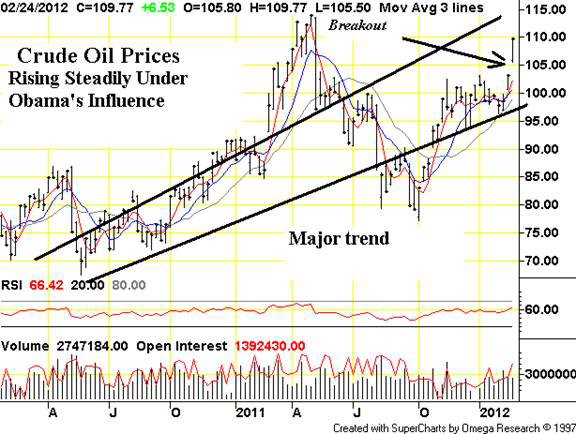
Rising in tandem with gasoline prices has been crude oil.  As you can see from the chart below, crude oil has risen almost 40 percent in the past two years and last week had an upward gap at $105 per barrel. This is a bullish signal and technically indicates the price of oil is going to go higher. More importantly, I think Obama will continue to provide the fundamentals for crude and gasoline to increase, perhaps another 40 percent higher if he is re-elected this November.
Crude Oil Prices Rising Steadily under Obama's Influence
While debating other GOP candidates last month, Newt Gingrich criticized Obama’s national energy program, saying it has been instrumental in driving the price of gasoline to $5 per gallon in some parts of the country.
“[America needs a new] energy policy, getting back to $2.50 a gallon gasoline, outlining both the economic and National Security implications, indicating that instead of bowing to a Saudi King we ought to be drilling, and our goal should be to be so independent that we don’t care what the Iranians are doing in the Straits of Hormuz,” Gingrich said.
That really is a pipe dream for Gingrich and it can only happen if a Republican is in the Oval Office next year.  Short of that, Obama’s pump dream of $8 per gallon gasoline is what we will have. That might good for Green backers and tree huggers, but it will cripple the recovery for the rest of the Nation that depends on affordable gasoline.
Yours in good times and bad,
–John Myers
Editor, Myers’ Energy & Gold Report
Editor’s Note: Last week, TransCanada announced it would move ahead with part of the Keystone XL pipeline, completing a section Oklahoma to Texas. This plan does not require Federal approval. In January, the Obama Administration rejected TransCanada’s proposal to build a pipeline from the Montana-Canada border through Nebraska because of pressure from environmentalist groups.

Wednesday, February 29, 2012

Your Offensive Obama Oil Policy Infographics of the Day... by Bill S. Feb. 28, 2012


Your Offensive Obama Oil Policy Infographics of the Day


If you’re looking for a single picture that captures the salient points of President Barack Obama’s oil policy, here it is. Courtesy of the Republican Study Committee:
This was timely, given Steve Maley’s excellent posting yesterday on the “10 Ways Obama Could Reduce Gas Prices Now“. Now some on the Left, including the President himself, are trying to convince us that there’s nothing he can do to bring gas prices down in the short term. And in fact it is pretty obvious that his administration’s policies are diametrically opposed to the idea of reducing prices in the first place (witness the Steven Chu quote cited in the infographic). But as my colleague Steve posted in his RedHot tweet last night, there is ample evidence that past Presidential actions have resulted in just such immediate relief as Obama and his minions deny are possible…behold, the second best infographic of the day:
(source: energytomorrow.org)
Despite the feeble efforts of the Left to excuse Obama’s offensive energy policy as having little or no impact on gas and oil prices, the evidence speaks for itself. Not only have the policies of the Obama administration had an adverse impact on the price of oil, but theseanti-oil policies are probably hindering the economic recovery that the President supposedly seeks. But hey, Obama’s tree-hugging buddies are pleased as can be at his eco-pandering and continued efforts to use government money to shore up an “alternative energy” industry that is neither profitable nor practical.  While Obama and Chu continue to peddle lies about the oil and gas industry, they stick us with the price tag for follies like Solyndra.  As Marita Noon describes, it’s “Obama’s Fake Fossil Fuel Infatuation“:
While greens describe Section 1603 as a program that “provided grants in lieu of tax credits to small renewable companies,” free market, fiscal conservatives—who don’t like subsidies in the first place—would be outraged if they understood how the program is really used. The PTC gave owners of wind turbines a tax credit of 2.2 cents per kilowatt-hour (kWh) of electricity produced during the first 10 years of operation. A 50 MW installation operating at an average capacity factor of 30% would generate 131,000,000 kWh per year. The owner would receive a PTC of $2,891,000 per year or $28,910,000 over 10 years. However, Section 1603 allowed the turbine owners to take a “cash grant” equal to 30% of capital costs up front ($100-120 million, 30% = $30-36 million) that came directly from the US Treasury—whether or not the turbine ever produced any electricity. This removes the performance risk for the developer and allows projects with a marginal net capacity factor to get built—even though, like Solyndra, the project doesn’t attract enough private investment. Plus, the cash grant is a “grant,” not a loan. The government doesn’t expect any money back. With the money taken up front, rather than annually based on actual production, turbine owners do not have the incentive to keep up the costly maintenance, and the turbines can eventually be abandoned. Additionally, much of the money is given to foreign companies—not “small renewable companies.”
These brief samples of President Obama’s priorities, as outlined in his proposed budget, highlight the flaws of his ideology. Instead of building on strength, it builds on failure. Renewables have repeatedly proven that they are more expensive than traditional fuels and are unwanted—requiring mandates and government programs to create an artificial market. There are thousands of abandoned wind turbines rusting in the wind. There were no buyers for Solyndra. Their stock of solar tubes were tossed in the trash. Fledgling companies from all segments of the renewable industry have gone bankrupt. They were surviving solely on subsidies and couldn’t compete without the frequent cash infusions. Yet, the budget promises them billions more—good money thrown after bad.
Peter Morici, of the University of Maryland Smith School of Business sums it up well:
Under Mr. Obama’s stewardship, the U.S. economy is not recovering as it should. As per usual, the president distracts public attention from poor policy choices by blaming and ridiculing others.
After three years, the president, who promised Americans millions of clean energy jobs in place of a thriving petroleum industry and much lower unemployment, should own up to his mistakes. Most Americans are needlessly paying too much for gas and foreign oil, while federally subsidized solar and wind projects are filing for bankruptcy.
This November, poor judgment and weakness of character—such as the president’s repeated attacks on the petroleum industry and failure to take responsibility for the consequences of his actions—make the most compelling case for change.
Americans should not expect a perfect president but at least one who bases decisions on facts not whimsy, and learns from mistakes.
Americans are simply not getting fact-based leadership and good judgment from President Obama.
The infographic does tell the story:
  • Inauguration Day, 2009:  $1.92 a gallon.  Today: $3.72 a gallon.  
  • Chu: “Somehow we have to figure out how to boost the price of gasoline to the levels of Europe” 
Yay, Obama Energy Policy!

Monday, February 27, 2012

10 Ways Obama Could Reduce Gasoline Prices. by Steve Maley, Feb. 25, 2012

Tulsa World headline:

Obama: No magic bullet to lower gas prices

WASHINGTON — President Barack Obama says there is no easy answer to the problem of rising energy prices, dismissing Republican plans to address the problem as little more than gimmicks.
“We know there’s no silver bullet that will bring down gas prices or reduce our dependence on foreign oil overnight,” Obama said Saturday in his weekly radio and Internet address.  …
Obama said Republicans have one answer to the oil pinch: Drill.
“You know that’s not a plan, especially since we’re already drilling,” Obama said, echoing his remarks earlier in the week. “It’s a bumper sticker.”
Speaking of bumper stickers, remember “Yes We Can”, Mr. President? No one understands the concept better than the oil and gas industry. The main thing holding domestic energy companies back from making a stronger commitment to future domestic supplies is uncertainty. Capital hates uncertainty, avoids it like the plague. Your rhetoric may appease your doctrinaire base, but it makes domestic energy producers hold back, fearful that you will punish their success, or that you will change the rules on them in the middle of the game.
Erasing uncertainty is the #1 thing you can do as a national leader if you truly desire to lower gasoline prices. Not only could it change the psychology of energy investing, there is still time for companies to change their 2012 investment plans.
Below the fold is my humble 10-point plan: Things President Obama could (but won’t) do to reduce domestic gasoline prices by November 2012.
1.  Commit to a strategic goal of North American energy security. That includes reasonable and responsible domestic drilling. That includes taking the lead on the Keystone XL Pipeline; we could find a way to make it happen while addressing the legitimate environmental concerns of Nebraskans. It includes a commitment to maintaining the Trans-Alaska Pipeline System and opening ANWR.
2.  Ditch the anti-industry, anti-capitalist rhetoric. It is not the President’s or the government’s place to decide when an industry’s profitability is “high enough”. High oil company profits fund more drilling; more drilling means more future supply and lower prices. Besides, American oil companies are not owned by a cabal of wealthy executives, but by America’s pension funds, mutual funds and private investment accounts. “They” are “us”.
3.  Stop targeting the oil industry for punitive tax treatment. States such as Texas and Louisiana have production tax abatement programs that have successfully encouraged new drilling. If you don’t believe that the threat of increased taxes discourages drilling, just ask Governor Perry or Governor Jindal.
4.  Realize that Uncle Sam is in the energy business and is a partner in industry’s success. Oil and gas royalties are the federal government’s #2 source of revenue, after the income tax. Offshore slowdowns hurt not only industry and jobs, but government revenue.
5.  Recognize that industry does not need to be led by government; industry needs to be unleashed and encouraged to innovate. The resurgence of the domestic energy sector was rooted in the private sector, not matter how much President Obama and Dr. Chu would like to take credit for it. The growth in North Dakota, Pennsylvania and Texas happened in spite of the federal government, not because of it.
6.  Trust that no oil operator wants to be the “next BP”. The BP spill cost that company something on the order of $40 billion. Industry safety and environmental commitment is motivated more out of self-interest and less out of fear of the government. When it comes to federal regulation, the nation would be better served by Sheriff Taylor, not Barney Fife.
7.  Return offshore permitting to the pre-Macondo pace.  Your overreaction to the BP Spill has cost on the order of 500,000 barrels per day of domestic oil production from the Gulf of Mexico. The ridiculous “Worst Case Discharge” calculation as a routine part of offshore permitting is engineering malpractice, in my humble opinion. The professional staff of the Bureau of Safety and Environmental Enforcement is capable of reasoned regulation, but they currently operate in fear of their political masters.
8.  Declare hydraulic fracturing & well design to be the regulatory domain of the states, not the EPA. Geology and environment vary widely; Pennsylvania is not Louisiana is not North Dakota is not California. It is insanity to think that one broadly-applied set of rules can be applied to regulate industry without suffocating development.
9.  Rescind the recently-enacted royalty rate increase for new onshore Federal oil and gas leases. Secretary Salazar’s stated rationale for increasing the government’s take by a whopping 50% – from 12.5% to 18.75% of gross production – was to equate onshore royalties with the offshore royalty rate. That makes no sense. Higher royalties mean less drilling, poorer economics of production and premature abandonment of wells. Besides, an IHS-CERA Study recently showed that the federal government’s total take of offshore cash flows makes the Gulf of Mexico the second-most punitive fiscal regime in the world, after Hugo Chavez’s Venezuela. [Update: In keeping with the First Rule of Holes, rolling back the royalty rate increase may be the first thing the government should do if it is serious about reducing energy prices. - Ed.]
10. Encourage development of a nationwide distribution system of natural gas as a transportation fuel. Natural gas is clean, abundant and nearly 100% domestic. Its potential as a transportation fuel has scarcely been tapped.
Bonus #11: Get real about the promise of alternative fuels. Recently you said: “You’ve got a bunch of algae out there; If we can figure out how to make energy out of that, we’ll be doing alright.” Maybe so, but I will stick my neck out and say it ain’t gonna happen, at least not in my lifetime, not on a scale that will impact pump prices.
Energy policy will be a President Obama’s key vulnerability in November. His goal has always been to encourage alternative fuels by raising conventional energy prices. Alternative energy may poll well, but the average voter who fills his tank with $4+ gas on the way to the ballot box will certainly “Hope for Change”.
Cross-posted at stevemaley.com.