GAS PRICES: Did oil firms manipulate market, senators ask
2
0 5A Text Size

Howdy, This Here is the BS-Ranch, The Ranch looks after a small amount of land located in the Inland Empire, but we also take notice to Things that are going on in the Owens Valley. We Welcome to the Ranch Pasture, Barns, and Corrals! But, if your not minding your feet you will have a Smelly Mess to clean off your boots when you leave.. Have a good time I hope you enjoy Da' BS.Ranch!
2
0 5

Gerard has led API since November 2008, expanding its membership and influence in all 50 states and globally, adding offices in Dubai and Singapore to its operations in Beijing, enabling API to better inform the public and policymakers on important energy issues. API's Washington presence is the foundation for the oil and natural gas industry's advocacy and outreach at state, federal and global levels on public policy, standards and certification programs, and as the source for information on industry best practices.Gerard is recognized by numerous publications and his peers as one of Washington's most influential advocates.Washington Life magazine named him one of the city's "Power 100" and a Fortune magazine profile said Gerard's effort to build a 50 state advocacy network for the oil and natural gas industry was "showing signs of success" through its outreach to workers and non-traditional allies.Prior to joining API, Gerard served as president and CEO of the American Chemistry Council, and earlier held the same position at the National Mining Association. Gerard also spent close to a decade working in the U.S. Senate and House. He came to Washington in 1981, and worked for Rep. George Hansen. He also worked for Sen. James A. McClure, who chaired the U.S. Senate Energy and Natural Resources Committee.
Kevin Freeman is considered one of the world's leading experts on the issues of Economic Warfare and Financial Terrorism. He has consulted for and briefed members of both the U.S. House and Senate, present and past CIA, DIA, FBI, SEC, Homeland Security, the Justice Department, as well as local and state law enforcement. He has traveled extensively with research trips to Russia and China and throughout Europe and the Americas.
That's factually correct, but let me tell you why it's misleading. The reason our imports are down is because demand in the United States has dropped significantly because of the recession. So either the President is impliedly taking credit for the downturn in the economy or he's taking credit for the increase in domestic production, which is what we in the industry have done on state and private land.

- Jan. 7, 2010 – The Obama administration announces new bureaucratic hurdles to American energy production that Secretary Salazar admitted “could add delays to the leasing and drilling process.” Gas is $2.67 a gallon.
- March 31, 2010 – Instead of opening new areas to energy exploration and development, President Obama blocks deep-ocean energy production on 60 percent of America’s Outer Continental Shelf. Gas is $2.80 a gallon.
- Dec. 1, 2010 – The president re-imposes and expands the moratorium on offshore energy production. Gas is $2.86 a gallon.
- Jan. 2, 2011 – TIME reported that the Obama administration issued the first in a series of regulations on January 2 designed to unilaterally impose a national energy tax. Gas is $3.05 a gallon.
- May 5, 2011 – The White House issues a formal statement opposing House-passed Restarting American Offshore Leasing Now Act and Putting the Gulf of Mexico Back to Work Act, legislation designed to jumpstart [sic] American energy production, address rising gas prices, and help create new jobs. Gas is $3.96 a gallon.
- June 21, 2011 – The White House opposes the House-passed Jobs & Energy Permitting Act that would unlock an estimated 27 billion barrels of oil and 132 trillion cubic feet of natural gas. Gas is $3.65 a gallon.
- Nov. 8, 2011 – The Obama Administration releases a plan for a five-year moratorium on offshore energy production, placing “some of the most promising energy resources in the world off-limits,” according to the House Natural Resources Committee. Gas is $3.42 a gallon.
- Jan. 18, 2012 – President Obama rejects the bipartisan Keystone XL pipeline and the more than 20,000 jobs that would come with it. Gas is $3.39 a gallon, and rising faster and earlier than ever before.

WASHINGTON — President Barack Obama says there is no easy answer to the problem of rising energy prices, dismissing Republican plans to address the problem as little more than gimmicks.Speaking of bumper stickers, remember “Yes We Can”, Mr. President? No one understands the concept better than the oil and gas industry. The main thing holding domestic energy companies back from making a stronger commitment to future domestic supplies is uncertainty. Capital hates uncertainty, avoids it like the plague. Your rhetoric may appease your doctrinaire base, but it makes domestic energy producers hold back, fearful that you will punish their success, or that you will change the rules on them in the middle of the game.
“We know there’s no silver bullet that will bring down gas prices or reduce our dependence on foreign oil overnight,” Obama said Saturday in his weekly radio and Internet address. …
Obama said Republicans have one answer to the oil pinch: Drill.
“You know that’s not a plan, especially since we’re already drilling,” Obama said, echoing his remarks earlier in the week. “It’s a bumper sticker.”
company
something on the order of $40 billion. Industry safety and
environmental commitment is motivated more out of self-interest and less
out of fear of the government. When it comes to federal regulation, the
nation would be better served by Sheriff Taylor, not Barney Fife.January 12, 2011 by John Myers

Welcome to 2011; another year for President Barack Obama, whose energy policies are dictated not from the White House but from Abu Dhabi and Riyadh.
Obama's Christmas gift to the nation was the December announcement by the President himself to clamp down further on domestic oil and gas drilling. Welcome to the New Year where pump prices now average more than $3 per barrel.
Despite the worst recession since the Great Depression, we are paying the highest gas prices since 2008. All thanks to Obama's need to go Green, which is enriching Arab oil producers while putting America's future at risk.
Obama regulators have been busy slipping in ill-advised energy policies. First came the pre-Thanksgiving announcement that oil exploration and drilling in Alaska would be curtailed. All for a good cause, said the Obamaites, to help save vast expanses of polar bear habitat. Then Obama's Department of the Interior made a pre-Christmas policy change that would further cut domestic oil supplies by making energy-rich lands untouchable.
It seems that Obama forgot that designating Federal lands as wilderness areas was supposed to require an act of Congress. Yet the day before Christmas Eve, Obama's Department of the Interior did a coup d'état. As a result, the Obama administration alone is able to judge where oil can or cannot be drilled. In doing this, Obama has thwarted George W. Bush's policy that restricted unilateral action by the White House.
Then there is the drilling in the deep-water Gulf of Mexico. Nearly three months after the Obama administration lifted its ban, oil companies are still waiting for approval to drill the first new oil well in the Gulf. In fact, the petroleum industry expects the wait to continue until the second half of 2011, and perhaps well into 2012.
This long delay by the Obama administration is costing Big Oil billions of dollars that they have tied up in Gulf projects; projects that are now on hold while petroleum companies pay out thousands of dollars every day on rigs that stand idle.
Last week the Wall Street Journal wrote this indictment of Obama' energy policy:
"Their impact goes beyond the oil industry. The Gulf coast economy has been hit hard by the slowdown in drilling activity, especially because the oil spill also hurt the region's fishing and tourism industries. The Obama administration in September estimated that 8,000 to 12,000 workers could lose their jobs temporarily as a result of the moratorium; some independent estimates have been much higher.
"The slowdown also has long-term implications for U.S. oil production. The Energy Information Administration, the research arm of the Department of Energy, last month predicted that domestic offshore oil production will fall 13 percent this year from 2010 due to the moratorium and the slow return to drilling; a year ago, the agency predicted offshore production would rise 6 percent in 2011. The difference: A loss of about 220,000 barrels of oil a day."
All of which leaves America more susceptible to an Arab oil embargo. The last one happened in the 1970s when the U.S. was pumping twice as much oil as it is now.
With the U.S. gulping more foreign crude than ever, Arabs could bring America to its knees. You would think that a President as smart as Obama would understand the risk he is putting the nation in; a nation which he has sworn to protect.
Perhaps the greatest waste of American resources is out West where there is potentially hundreds of millions of barrels in oil reserves and trillions of cubic feet in gas deposits; all of it just waiting to be drilled and pumped to a thirsting nation. Yet our President is obstructing America from meeting its energy needs.
Ben Lieberman of The Washington Times explains:
"Utah is particularly hard hit, with up to 6 million acres in jeopardy of being locked away from development. Rep. Rob Bishop, Utah Republican, told The Salt Lake Tribune, "[This decision will seriously hinder domestic energy development and further contribute to the uncertainty and economic distress that continues to prevent the creation of new jobs in a region that has unduly suffered from this administration's radical policies."
But there is more. Two days before Christmas the Environmental Protection Agency (EPA) undertook a Pearl Harbor-like pre-emptive attack on U.S. refiners with an order that will place severe limits on carbon-dioxide emissions. The EPA, in language Joseph Stalin would have been proud of, said: "The details have yet to be determined."
The Moroccan Candidate
The bottom-line is that under Obama, Washington is certain to increase the cost of converting oil into gasoline. If you are looking forward to spending $5 per gallon at the pumps, you will love Obama's bold new move to make America more green.
The $5 per gallon is not just a number I picked out of the air. The former president of Shell Oil says that's entirely possible as high demand pushes the price of crude oil higher and higher.
Culminating some time by the third quarter of 2012, retail pump prices in places like California and New York will reach roughly $5 per gallon, said former Shell Oil president John Hofmeister.
Former energy secretary Bill Richardson was asked about Hofmeister's stark prediction: "I hope he's wrong, but this is a very volatile energy market and we haven't moved as fast as we should in America towards reducing our dependence on fossil fuels."
Hofmeister underscores the urgent need to develop domestic oil production and he even accuses the Obama administration of being anti-oil.
"I have no problem moving beyond oil but not today, not tomorrow, not 2011 or 2012. We can't. It's simply impractical and unreal," Hofmeister said.
Meanwhile, the Department of Energy (DOE) has put out a statement saying it will continue to pursue responsible oil and gas production while focusing on vehicle efficiency standards and investing in electric vehicles, bio-fuels and mass transit.
Obama's DOE must think America alone can make the Earth green. What the President seems to forget is the fact that China, India and Russia, along with a host of Third World polluters, are using coal and even wood furnaces to drive their industries.
It appears to me that Obama's Green policies are nothing more than collateral damage to a nation that needs domestic petroleum and the jobs that that industry provides. Instead Obama's policies seem to be helping Arab oil exporters.
If you think I exaggerate, consider this from the Dec. 29 Economist, not known as a bastion of conservative ideals: "Mr Obama's team of managing the Middle East is even more inept than Mr Bush's. The American right and many Israelis think he is too pro-Arab."
Dubya Billboard: "MISS ME YET?"
People in the petroleum industry don't believe Obama is pro-North America, at least not when it comes to energy. Canada's oil sands — which help keep America on the road every day—have been labeled "dirty oil" by Obama Democrats (as if the crude they pump out of the Saudi desert was somehow clean). And given the political realities that exist in many parts of Alaska, Sarah Palin has a greater chance of hitting a gusher with an errant shot from her AR-15 than Big Oil has with a drill-bit.
Despite Bush's multiple mistakes in the Middle East, he was a patriot who at least wanted to ramp up domestic oil and gas production. That's not true of Obama, who seems intent on increasing America's dependency on Arab oil.
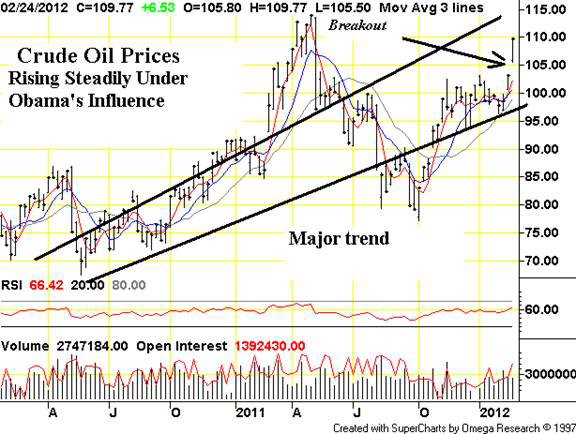
As I write to you, oil has topped $90 per barrel. I believe that by summer it will break over $100 per barrel. That makes Big Oil a good investment. But at what cost?
Under Obama's presidency we are headed for an energy crisis worse than anything President Jimmy Carter could have engineered. Just how high oil prices will go I don't know. Much depends on what happens in the 2012 election.
Yours in good times and bad,
John Myers
Myer's Energy and Gold Report
Jeffrey Spring, spokesman for the Auto Club of Southern California, said Friday that gas in San Bernardino and Riverside counties costs 25 cents less than it did last month and 8.6 cents less than last week.
Fuel prices have fallen about a penny a day in the past month, with consumers now paying 7 cents less than they did this time last year, Spring said.
Darrell Lewis of Fontana said he was relieved by the lower gas prices.
"I think it's great," said Lewis, 18. "I don't have money to pay high gas prices."
It's already made about a $20 difference in his budget, he said.
For Dan Cross, 44, of Temple City - who filled up at $3.05 a gallon at an Arco station on Archibald Avenue in Ontario - the new numbers mean more family outings.
"Instead of putting it in the gas tank, I can take my boys out to the beach and spend it going fishing," Cross said.
While the decreasing prices are good news for those planning a summer road trip, some are still skeptical.
"It scares me," Veronica Moran, 33, said at a Thrifty station charging $3.03 a
gallon on Sierra Avenue in Fontana. "I think it'll go way up again all of a sudden."Spring said the volatile nature of gas prices in the past few years - with extreme highs and lows - are partly due to traders and analysts increasingly looking to make a buck in the market on oil and gas.
Another factor at play is unrest in the Middle East.
In years past, the price of fuel was primarily dictated by supply and demand, Spring said.
A hike in the spring is standard as refineries go out of commission to clean out their systems and do repairs before switching formulas for the warmer months, he said.
But since drivers in the region paid the highest ever - $3.48 a gallon - on May 8, the direction of gas prices has been decidedly downward.
Pricey commutes have influenced the patterns of drivers - including Spring - in recent years.
"It started to change my habits when it hit $2.50 a gallon two years ago," Spring said. "I started car-pooling, and I didn't hit the gas as much."
Eva Shipman, 65, of Rancho Cucamonga said the prices last month made her change her driving habits, too.
"It was terrible," Shipman said, while filling up for $3.05 a gallon at a Sam's Club station on Milliken Avenue in Ontario. "I drove less, and I tried to do everything while I was out."
Silvia Vargas, 42, of Perris said she isn't celebrating the lower prices just yet.
"It's still too high. I'm a mother of eight who has to (drive) kids back and forth to school and to work," Vargas said, sitting among seven passengers in a Ford Excursion at the Thrifty station in Fontana.
"It affects us. It has gone down, but not low enough."
Spring said if things hold out, gas prices at many stations in the region will be below $3 a gallon in the next weeks.
Linda Wubker, 47, of Fontana said the lower gas prices today are all a matter of perspective.
"When it hit $2, we were really upset," Wubker said. "Now we're all happy that it's hit $3."
Staff writer Selicia Kennedy-Ross contributed to this report.
6/15/02-6/14/03: $1.72
6/15/03-6/14/04: $1.94
6/15/04-6/14/05: $2.27
6/15/05-6/14/06: $2.75
6/15/06-6/14/07: $2.94
6/15/07: $3.22
- Auto Club of Southern California
-----------------------------------------------------------------------------------------------------------------------
BS Ranch Perspective
The Announcement was just out on Sunday that Gas prices was down to $3.00 a Gallon, and which was great information. We will see how long it will last. I guess that people have not been going anywhere or doing anything this summer and the people have been staying home. Now they lower the price and entice the Americans to venture out and Vacation!
BS Ranch
OIL PRICE GOUGING: FROM ENRON WITH LOVE
David R. Usher
June 9, 2007
NewsWithViews.com
Remember what Enron did to California and millions of investors? It took advantage of deregulation in California, manipulating electricity prices by raiding the futures market, overscheduling power lines, and creating fears about shortages. PG&E went bankrupt because it could not raise rates to customers.[1] The whole thing unraveled, and Enron went down in flames in the biggest bankruptcy in American history.
Enron was a clumsy corporate attempt to raid a captive energy market. It was also a proving grounds testing how much monkey business a single corporation can get away with. Savvy investment firms and avaricious lawyers analyzed the Enron case – realizing they could turn a huge buck on oil futures – so long as they tacitly let oil companies constrain the oil supply without manipulating the supply directly themselves.
Giant speculative investment funds and oil companies now make tremendous profits raiding the oil spot-market, playing seemingly separate but implicitly cooperative roles serving up the same end-effect as Enron wreaked on California. But this time, the victim is the American consumer, not energy producers and distributors.
Federal and state politicians in both parties have failed to address this "Enroning of America" because government is on the take too. Taxes rise with gasoline prices, fattening political contributions while feeding slush budgets and pork barrels at both the state and federal levels.
Oil companies grin like Howard Stern on satellite because outrageous spot market prices drive windfall profits. Record oil-company windfall profits are derived from gross internal company book-value transfers of oil products made between offshore divisions to U.S. operations – the value differential pegged to spot market prices – which also has the concurrent effect of exporting tax liabilities overseas.
Fears of global warming, fears of shortages due to weather or minor refinery disruptions, Middle-East stability, and consumption in China have turned high gasoline prices into an honorable predation in service of imaginary higher moral and political purposes.
National Public Radio first documented this problem in its story "Analyst: Blame Investors for High Gas Prices."[2] The story revealed a truth: "Investment banks from Morgan Stanley to Goldman Sachs are making so much money from oil futures that they've become a hot investment for all sorts of big-money players." Ben Dell, an oil analyst and Sanford Bernstein calls it correctly, if not conservatively: "pension funds and other investors are buying oil to remove it from the market -- which can help drive up demand -- before selling it for a profit some months later":
Dell thinks that mass speculation will end when production capacity meets demand. This is a backwards analysis. Production capacity will never meet demand so long as mass speculation makes unproductivity immensely profitable. According to the International Monetary fund (IMF), oil companies have not invested in additional production capacity – thus intentionally maintaining record oil company profits.[4] Oil companies are negatively motivated to increase capacity in the speculatively-manipulated market because they reap tremendous profits by sitting on their thumbs.
Gouging by playing "Fear Factor"
Oil companies normally buy some spot oil futures against excess production by other oil companies to make sure they will have enough crude. In this legitimate market, there are only so many dollars chasing so many excess barrels of future oil.
Pension and other large speculative bank-owned investors discovered they could manipulate the market out of sheer size. By making huge purchases of futures, they could accelerate fears, take oil offline, drive the price up even more – and make handsome profits in just a few weeks or months. The spot market is now distorted – too many dollars chasing around the same amount spot oil. Minor fluctuations in gas prices became wide swings. The word "hurricane" is all it takes to provide cover for raiders to buy in. Over time, the constant pressure to maintain futures profits has caused steep, consistent rises in baseline crude and refined prices over the past five years.
Analyzing the roughly 566% increase of crude oil prices since 1995,[5] accompanied by a parallel rise in refined-gasoline prices, the International Monetary Fund (IMF) admits that fear is the major factor driving oil price gouging:
"Naturally, given the tightness in the oil market and uncertainties about demand and supply, factors such as geopolitical developments, fears of potential supply disruptions, and speculation have also all played a part in price movements, but largely through their impact on expectations regarding future fundamentals."[6]
After identifying fear as the major factor, the IMF absolved its institutional friends manipulating those fears, suggesting the effect of entry into the market by Hedge and pension funds merely adds "diversity" to the market that can "be a source of liquidity and price discovery."[7] Read between the lines, America: the IMF just admitted that banks and pension funds are "discovering" new oil prices by flooding a brittle market with paper purchases, and laughing all the way back to the bank.
Is There Really an Oil Shortage?
In 1978, I flew to Europe to visit a college friend who worked in London. An oil-trader friend of his from Paris flew in for a weekend restaurant tour with us. When I asked the man what he did for a living, he replied confidently "I f*** the world". I was shocked then, and even more-so today.
If data by the United States Energy Information Agency (EIA) is reliable, there is no actual shortage of either oil or production capacity in relation to consumption.
Between 1980 and 2004, world consumption increased by 30.8%,[8] while U.S. consumption increased only 21.5%.[9] World production increased 23.2%,[10] but U.S. production actually decreased by 40.3%.[11]
In terms of world static supply and demand, in 2004 73,387 thousand barrels/day (TBD) of oil were produced,[12] against demand of 82,594 TBD consumed.[13] This would leave a 12% structural deficit. However, looking at 1980 world data, we also see a 5.7% deficit: 59,557 TBD were produced[14] against consumption of 63,113 TBD.[15]
The EIA data suggests a long-term physical impossibility: world consumption has been actually outstripping world production for many years. I conclude there is data missing from EIA reports. This could consist of under-reporting of production, over-reporting of consumption, or perhaps both.
World distillation capacity rose 81% from 47,049 TBD in 1970, to 85,304 TBD in 2007. However, distillation capacity increased only 6.7% between 1980 and 2007.[16] It is interesting to note that the EIA reports 2007 distillation capacity of 85,304 TBD, which factoring-in demand growth, is roughly in-line with 2004 consumption of 82,594 TBD (post-2004 consumption data is not available yet.
In the United States, distillation capacity actually decreased from 17,988 TBD in 1980 to 17,397 TBD in 2007. The lowest point in U.S. distillation capacity occurred in 1994, when capacity was only 15,034 TBD.[17]
Proven reserve data suggests a very positive future outlook. Proven U.S. reserves rose 734% from 29.81 billion barrels in 1980 to 213.32 billion barrels in 2004.[18] Proven world reserves grew 204% from 644.93 billion barrels in 1980 to 1,317.44 billion barrels in 2007.[19]
Now, we look at spot-market oil prices. In 1974, oil cost about $5 per barrel. By January, 1980 oil nearly quintupled to $24 per barrel. It dropped to a low point of $9.50 in 1999, skyrocketed to $58 per barrel in 2005,[20] peaking at $69.52 in August, 2006.
We see that oil prices exploded 173% between 1999 to August, 2006.[21] This is a breathtaking change for a necessary commodity.
Is there really a shortage? We can say conclusively that we have not seen gas lines in any free world country. This suggests there is no actual shortage in either the United States or the world.
Here is what we can take away from the above information:
1. U.S. oil companies cut back U.S. distillation capacity substantially between 1980 and 2004. This seeded fears. Spot market prices rose tremendously, thus increasing profits to oil companies.
2. U.S. oil companies decreased stateside production 40.3% between 1980 and 2004, driving fears about dependence on foreign oil, and creating an illusion that shortages were imminent.
3. These two items, in conjunction with speculative manipulation of the spot market by banks and pension funds, caused oil company profits to soar. The world's three largest oil companies netted profits of $172,000 per minute during the second quarter of 2006. Profits going forward look similarly bullish.[22]
The Effects of Inflated Energy Costs
Enronesque oil speculation disproportionately affects low-income Americans to the immediate benefit of oil companies, governmental bodies, and upper-class investors. The poorest Americans can least afford transportation, thus marginalizing them.
Economists believe that maximizing private retirement funds will result in lower demands on Social Security as baby-boomers retire. However, the high present-day cost of oil decreases what individuals can afford to contribute to their retirement funds – perhaps taking marginal investors out of the contemporary investment picture entirely.
Robbing the bank today to save the bank tomorrow is a zero-sum game. When low-income Americans can no longer afford to drive longer distances getting to work, they settle for lower wages available close to home. In inner-city and remote rural locations, where employment opportunities are scarce or non-existent, employment may no longer even be feasible. Present-day welfare demands can be predicted to rise, and social security contributions predicted to fall.
This problem is not limited to oil markets. In the name of "deregulation", investors are now raiding electricity markets nationwide. This is driving up home energy costs for everyone, causing utility companies to defer lifecycle replacement of end-of-life equipment, resulting in massive power outages caused by wet or cold weather failures of antiquated step-down equipment never before experienced by customers.
For example, several extended power outages in Missouri affecting over ½ million customers each can be attributed to failure of Ameren U.E. to proactively replace old step-down transformers, which explode when rusting enclosures permit moisture entry during inclement weather. Here is proof: this past February, I counted seven step-down transformer explosions, on one day, within earshot of my home after a large wet snowstorm.
Clearly, constraints must be applied to all energy markets to ensure free resource exchanges within markets undistorted by giant speculative investors.
High energy costs make international outsourcing of manufacturing and exportable service industries attractive in countries where workers commonly walk, use public transportation, ride bicycles, or live in corporate dormitories. High energy costs also raise the bar at which Americans will work, making illegal immigration more attractive to foreigners and American businesses.
The Answer
The U.S. House of Representative recently passed oil price-gouging legislation that would force the major oil companies to break up.[23] This feel-good legislation will not fix the problem because it does not change the passive but orchestrated role played by oil producers and speculators profiting from the gouging game.
For many years, Presidents and politicians have repeatedly promised actions to reduce dependence on foreign oil, while knowingly permitting oil companies to decrease stateside production capacity and increase our dependence on foreign oil. The jig is up. No politician can survive without taking decisive action to end the "Enroning Of America." This must be one of the leading issues in upcoming Congressional and Presidential races.
Five things should be done. A free market will not exist until speculative investing is fully disallowed for critical energy commodities including oil and electricity:
1. Small investors holding retirement accounts should boycott investment firms and mutual funds that tout or place any of their funds in spot market futures. You do not gain by paying outrageous gas prices now only to be paid back in cheaper dollars later.
2. Consumer class-action lawsuits, perhaps invoking RICO should be filed against oil producers and investment firms, to recover illicit profits and return them to consumers. Governmental bodies who received windfall taxes should also be named and forced to return the taxes. With a case like this, it won't be necessary to shop the case out to the corrupt the corrupt bench in Madison County, Illinois.
3. Speculation must not be permitted in mission-critical markets. Congress must enact Federal legislation limiting spot-market trading in oil and utilities to companies that directly produce, refine, or sell oil.
4. Congressional hearings must be had to interview executives in both industries and discover the extent of monopolistic collaboration.
5. If information discovered in Congressional hearings and class-action suits warrants, criminal charges should be filed against executives in both industries who have knowingly collaborated to gouge the American consumer.
Footnotes:
1, Market Manipulation
2, National Public Radio, "Analyst: Blame Investors for High Gas Prices," August 24, 2006
3, National Public Radio, "Analyst: Blame Investors for High Gas Prices," August 24, 2006
4, International Monetary Fund, "The Structure of the Oil Market and Causes of High Prices," September 21, 2005
5, International Monetary Fund, "The Structure of the Oil Market and Causes of High Prices," September 21, 2005
6, International Monetary Fund, "The Structure of the Oil Market and Causes of High Prices," September 21, 2005
7, International Monetary Fund, "The Structure of the Oil Market and Causes of High Prices," September 21, 2005
8, U.S. Energy Information Agency, "International Petroleum (Oil) Consumption," June 5, 2006
9, U.S. Energy Information Agency "International Petroleum (Oil) Consumption," June 5, 2006
10, U.S. Energy Information Agency, "World Crude Oil Production (Including Lease Condensate), Most Recent Annual Estimates, 1980-2006"; May 25, 2007
11, U.S. Energy Information Agency, "World Crude Oil Production (Including Lease Condensate), Most Recent Annual Estimates, 1980-2006"; May 25, 2007
12, U.S. Energy Information Agency, "World Crude Oil Production (Including Lease Condensate), Most Recent Annual Estimates, 1980-2006"; May 25, 2007
13, U.S. Energy Information Agency, "International Petroleum (Oil) Consumption," June 5, 2006
14, U.S. Energy Information Agency, "World Crude Oil Production (Including Lease Condensate), Most Recent Annual Estimates, 1980-2006"; May 25, 2007
15, U.S. Energy Information Agency, "International Petroleum (Oil) Consumption," June 5, 2006
16, U.S. Energy Information Agency, "World Crude Oil Distillation Capacity, January 1, 1970 - January 1, 2007
17, U.S. Energy Information Agency, "World Crude Oil Distillation Capacity, January 1, 1970 - January 1, 2007
18, U.S. Energy Information Agency, "International World Proved Crude Oil Reserves, January 1, 1980 - March 12, 2007 Estimates"
19, U.S. Energy Information Agency, "International World Proved Crude Oil Reserves, January 1, 1980 - March 12, 2007 Estimates"
20, U.S. Energy Information Agency, "World Nominal Oil Price Chronology: 1970-2005"
21, U.S. Energy Information Agency, "United States Spot Price FOB Weighted by Estimated Import Volume (Dollars per Barrel)"
22, Bloomberg.com, "Exxon, Shell Exceed Profit Predictions as Prices Soar"
23, MSNBC, "House approves stiff gas-gouging penalties," May 24, 2007
© 2007 David Usher - All Rights Reserved
David R. Usher is Legislative Analyst for the American Coalition for Fathers and Children, Missouri Coalition and is a co-founder and past Secretary of the American Coalition for Fathers and Children.
E-Mail: drusher@swbell.net